
Edge 14 scored 460 on the HTML5 Test, putting Microsoft’s browser alongside Firefox for the first time. It was a large jump from Internet Explorer 11, although enterprise support still kept IE-specific workarounds alive.
The HTML5 Test Results
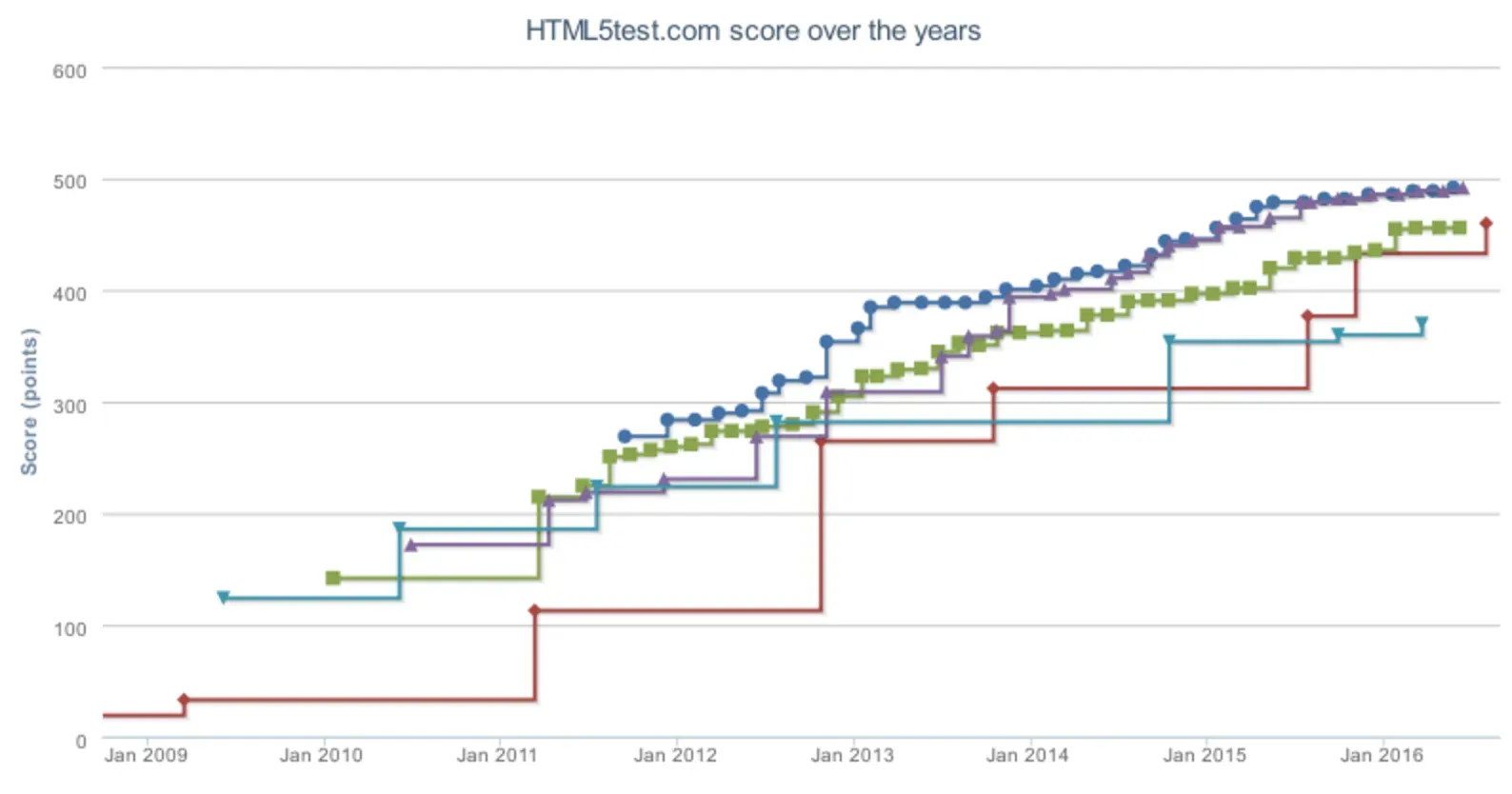
Edge14 (released tomorrow) is now right up there with Firefox on @html5test. 460 points. (473 with flags)
Edge 14 scored 460 points on the HTML5 Test (473 with experimental flags). This put it on par with Firefox—a huge leap from Internet Explorer 11’s dismal showing.
Why This Mattered
Microsoft spent the Internet Explorer era actively hostile to web standards. Developers wrote browser-specific hacks and maintained separate codebases. Edge was Microsoft’s commitment to change that.
| Browser in August 2016 | HTML5 Test score | What the score represented |
|---|---|---|
| Chrome | ~520 | The clear leader |
| Opera | ~515 | Chromium underneath |
| Firefox | ~460 | A competitive independent engine |
| Edge 14 | ~460 | Microsoft finally reached Firefox’s range |
| Safari | ~370 | Apple’s slower standards rollout |
| IE11 | ~312 | The compatibility burden developers still carried |
The score showed how far Microsoft’s new engine had come. It did not mean developers could drop IE-specific hacks yet; enterprise users were still stuck on IE11.
What Changed with Edge 14
Microsoft’s anniversary update brought real web development improvements:
CSS Grid Layout: Early implementation of the then-new grid standard
Web Notifications API: Desktop notifications from web apps
Beacon API: Better analytics tracking
Fetch API: Modern replacement for XMLHttpRequest
CSS Custom Properties: Variables in CSS (though limited support)
These weren’t just checkboxes on the HTML5 Test. Developers wanted to use these features but couldn’t because of IE’s dominance in enterprise.
The Enterprise Problem
While Edge improved rapidly, most enterprises stayed locked into IE11 due to internal tooling dependencies. Microsoft’s modernization of Edge didn’t solve the real problem: backwards compatibility commitments meant IE11 would persist for years.
That limited the real-world benefit. Edge could support a feature perfectly while enterprise compatibility requirements still forced developers to accommodate IE11.
Looking Back from 2025
Edge’s EdgeHTML era was short-lived. In 2019, Microsoft abandoned EdgeHTML for Chromium. This validated what many suspected: maintaining an independent browser engine requires resources even Microsoft struggled to sustain.
Edge 14’s competitive HTML5 Test scores weren’t fake—Microsoft’s engineers genuinely caught up. But catching up once isn’t enough. Chrome releases major updates every 6-8 weeks. Keeping pace with that velocity while maintaining an independent engine proved impossible.
Today’s Chromium-based Edge works well, but Microsoft gave up an independent browser engine to get there. The web lost some engine diversity, and Edge 14’s brief competitive moment looks smaller in hindsight.
One quick signal
Did this earn your time?
Thanks. That gives me something concrete to check.

About the author
KahWee Teng
I’m a staff software engineer in San Francisco. I write from systems I’ve built and maintained: frontend migrations, AI-assisted workflows, and hardware running at home.